
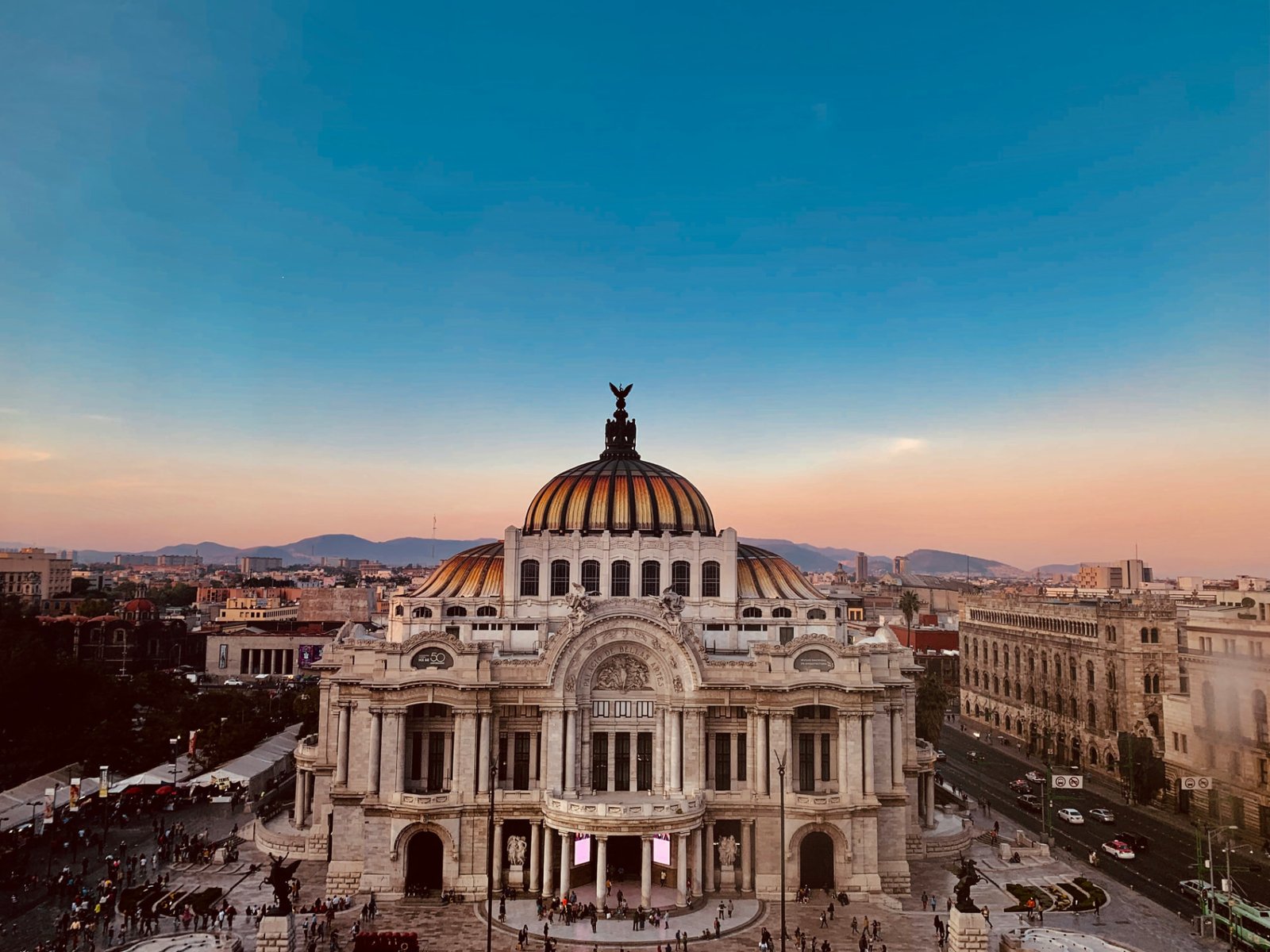
Mexico City

Calma guide · Valley of Mexico

Mexico City

A city you cannot see in three days, and still cross on foot.

Reviewed · 11 min read

Why here

Mexico City cannot be covered. Twenty-two million people spread across a valley at 7,350 feet, and any attempt to see all of it ends with a car stopped on Insurgentes. What you can do is pick three or four neighborhoods and walk them slowly, which is how the city lets itself be liked.

In one afternoon you eat at a fonda that opened in 1948, cross a market that smells of copal and end up at a taquería that is an auto repair shop by day. It is not a postcard-pretty city. It is dense, loud, and its street life does not stop.

This is not a resting trip, and it is not a weekend you check off. You lose real time in transit, there is noise and there is pollution, and the altitude is noticeable. If you are traveling to switch off, or if you expect to see the whole city in three days, you will end up frustrated. This city rewards staying.

Language
Spanish
Currency
Mexican pesos (MXN)

When to go

November

The rains have ended and the dry season begins with the air still clean. Days are mild and nights cool, and Día de Muertos is just behind you, so you catch the city with the altars still up and without that week's prices.

Late March, when the jacarandas bloom and the city turns purple for three weeks. The trade-off is the worst air of the year: the dry season accumulates pollution and the city declares air-quality alerts.

June through October it rains most afternoons, from four or five onward. Mornings stay clear and the valley turns green, but the storms are heavy, they flood underpasses and they collapse traffic. It travels well if you put the outdoor plans in the morning and the indoor ones after lunch.

Season or eventWhenWhat it changes
Día de MuertosOctober 31 – November 2The most in-demand dates of the year. Hotel rates spike and sell out months ahead. The parade down Reforma is a recent invention, copied from a James Bond film that staged one before the city had it — the traditional observance is in the cemeteries and in the altars of Coyoacán and Mixquic.
Grito de IndependenciaThe night of September 15The Zócalo is closed off and fills up. If you are staying in the Centro, expect blocked streets and noise until late.
Semana SantaMarch or April, depending on the yearThe opposite of the rest of the country: chilangos leave for the beach and the city half empties. It is the one week of the year you can drive and eat without lines. Many small businesses close.

Museums close on Mondays, almost without exception. If you only have a long weekend, do not make Monday your museum day.

Getting there

Flights to Mexico City.

Search flights and fares

From

Los Angeles

LAX

Duration

4h 15m

From

Houston

IAH

Duration

About 2h 30m

From

Dallas

DFW

Duration

About 2h 45m

From

New York

JFK

Duration

About 5h 30m

Common routes. Airfares change daily, so we do not fix a price here: search for your dates.

Where to stay

Where to stay in Mexico City.

See all stays
Consultando disponibilidad real en Mexico City

First, choose the neighborhood.

Choose the area before the hotel. In Mexico City, it changes the trip substantially.

Roma Norte

Art deco, tree-lined medians and the highest concentration of good food in the city.

A first visit. You leave the hotel and you are already where you want to be.

Keep in mind: It is what everyone picks, with what that means for prices and for loud weekends.

Condesa

Two parks, México and España, with life circling around them.

Travelers who want what Roma has, quieter and greener.

Keep in mind: At night you hear the bars on Nuevo León and Michoacán from indoors.

Juárez

Between Reforma and Roma, with embassies, Porfirian buildings and less of a postcard.

Anyone who wants to be at the geographic center and move on foot or by Metrobús.

Keep in mind: Its character changes block by block. Look at the specific block before booking.

Centro Histórico

The real city, built on top of the Aztec one. Dense, monumental and loud.

Anyone here for the history who wants to step outside and already be in it.

Keep in mind: It empties at night and the daytime noise is constant. It has the most street vending of any district.

Coyoacán

A low-slung town of plazas that the city swallowed without digesting.

Second visits, or anyone who would take quiet over being near everything.

Keep in mind: It is far. Count a good forty minutes to Roma, more at rush hour.

Where to eat

Where to eat in Mexico City, and exactly what to order.

Reference prices per person, in Mexican pesos (MXN).

Breakfast

People eat a real breakfast here, and early. Both of these are morning-only.

Fonda Margarita

Tlacoquemécatl del Valle · Adolfo Prieto 1364$ · 120–200

A fonda from 1948 serving stews out of clay pots, open mornings only.

What to order

Refried beans with egg, which is the reason the place exists, and chicharrón in salsa verde. With tortillas made to order.

Hours: Tuesday–Sunday, 6:30 a.m.–noon. Closed Monday.

The honest part: It closes at noon and there is a line from early: arrive at eleven and half the menu is already gone. Shared tables, and not a place to linger.

Panadería Rosetta

Roma Norte · Colima 179$$ · 150–350

Elena Reygadas's bakery, in a Roma townhouse.

What to order

The guava roll, which is the reason for the trip. And a concha — the flavor rotates, blue corn and hoja santa among them.

Hours: Monday–Saturday, 7:30 a.m.–8 p.m. Sunday until 5 p.m.

The honest part: There is always a line and it always moves. It fills with people photographing the guava roll; the bread survives the fame.

Lunch

Lunch runs from two to four. Before that the good places are half empty; after it there is no table.

Contramar

Roma Norte · Durango 200$$$ · 800–1,400

Fish and shellfish from the Mexican coast in a bright dining room, open since 1998 under Gabriela Cámara.

What to order

The tuna tostada and the pescado a la talla, half red and half green, eaten as tacos by the whole table. For dessert, the meringue cake with strawberries.

Hours: Daily 10 a.m.–8 p.m. Reservations for seatings from noon to 6:30 p.m.

The honest part: It closes at eight: this is lunch, not dinner, however much it sounds like a dinner restaurant. Reserve on OpenTable, which holds about half the tables; if there is nothing, the other half runs on a walk-in waitlist and it is worth showing up at 12:30 or 12:45.

Nicos

Clavería, Azcapotzalco · Av. Cuitláhuac 3102$$ · 400–800

Mexican home cooking since 1957, in a neighborhood no visitor reaches by accident.

What to order

The sopa seca de natas — layered crepes in tomato sauce — and the Caesar salad made at the table.

Hours: Monday–Friday 7:30 a.m.–7:30 p.m. Saturday 8 a.m.–7 p.m. Closed Sunday.

The honest part: It is far from everything and that is the point: you eat surrounded by neighborhood families, not by people with luggage. Budget for the ride.

Pujol

Polanco$$$ · 3,600–3,900 per person, tax included

Enrique Olvera's house, and the restaurant that rewrote how Mexican cooking is read. Two Michelin stars.

What to order

The mole madre: two concentric circles, one of the day's mole and one of a mole they have been feeding for more than a thousand consecutive days. At the bar, the taco omakase.

Hours: By reservation only, in two-hour seatings from 1 p.m.

The honest part: Book five to seven weeks out, through Tock. The price excludes drinks: the pairing adds about 2,500 pesos per person and the 15 percent service charge is separate. This is the big expense of the trip and it has to be decided before you arrive.

Dinner, which here means tacos

Both stay open into the early morning, and neither takes cards or reservations. You show up and you wait.

El Vilsito

Narvarte · Petén at Av. Universidad$ · 100–200

An auto repair shop by day and a taquería by night, in the same space, making no effort to hide it. The trompos go up where the cars were.

What to order

Tacos al pastor, cut off the trompo with the pineapple. And a gringa, which here is the honest version and not the tourist invention.

Hours: Monday–Thursday from 2 p.m. to 3 a.m. Friday and Saturday until 5 a.m. Sunday until midnight.

The honest part: The point is to go late, when all that is left is the shop turned taquería. By day it is literally a garage and there are no tacos.

Los Cocuyos

Centro Histórico · Simón Bolívar 56$ · 80–160

A counter from 1980 with a vat of lard bubbling in plain sight. A Michelin Bib Gourmand.

What to order

The suadero taco, which is what the line is for, and a campechano of suadero with longaniza. If you are game, the cabeza.

Hours: Daily, 10 a.m.–5 a.m.

The honest part: You eat standing, on the street, elbow to elbow. The address is number 56, steps from Madero, even though the neighboring units in the same building show as 57 and 59. It barely closes: at three in the morning there is still a line.

What to do

7 plans, from half a day to a full day.

The Centro Histórico on foot

The Zócalo, the Templo Mayor surfacing between the cathedral's foundations, Bellas Artes and the Torre Latinoamericana. It all fits in a long morning with no transportation between stops.

Half a dayIn town

Museo Nacional de Antropología

The best museum in Mexico and one of the best anywhere, in Chapultepec. Admission is 210 pesos for foreign visitors and 105 with Mexican ID or residency, 2026 INAH rates. Sundays are free for nationals and residents, which is why they are the most crowded.

Check before leaving: Closed Mondays, like nearly every museum in the city.

Half a dayTransportation needed

Coyoacán and the Casa Azul

Frida Kahlo's neighborhood, with its plaza, its market and the house where she lived and died. It pairs well with San Ángel on a Saturday, for the Bazar del Sábado.

Check before leaving: Casa Azul tickets are sold online only and time slots sell out days ahead. Closed Monday. Do not go without a ticket already bought.

Half a dayTransportation needed

Teotihuacán

The pyramids of the Sun and the Moon, about 30 miles northeast. Go first thing: there is no shade, and by midday the Avenue of the Dead is an oven. Same rates as Antropología, 105 and 210 pesos.

Full dayTransportation needed

Xochimilco

The chinampas and the canals left from the original lake, by trajinera. On a weekday it is a quiet ride between market gardens; on a weekend it is a floating party with mariachi. Two different plans under one name.

Half a day or a full dayTransportation needed

Lucha libre at Arena México

Friday nights. You do not need to understand any of it: buy at the box office, drink a beer and shout. It is one of the most honestly popular things the city has left.

One nightTransportation needed

Sunday bicycles on Reforma

Every Sunday except the last of the month, from 8 a.m. to 2 p.m., Paseo de la Reforma closes to cars. It is the only way to see the avenue empty, and the best way to understand the scale of the city.

Half a morningIn town

Getting around

From the airport to the center

AICM is inside the city, about 3 miles from the Centro, but traffic decides everything and the trip runs from twenty minutes to an hour. Authorized taxis are booked at a counter inside the terminal and charge by zone: Zone 1, the Alameda and the Centro, runs about 250 to 280 pesos, and Zone 3, which covers Roma and Condesa, runs 340 to 420 in a sedan. Metrobús Line 4 connects both terminals and costs 30 pesos, but reaching the Centro means transferring at San Lázaro — with luggage, at night, it is not worth it.

Around the city

The Metro costs 5 pesos a ride, goes everywhere and is the fastest thing available, but at rush hour it is genuinely packed. Uber and Didi work well and are what most people default to. You do not hail taxis off the street here: order by app or from a stand.

Distances

This is the mistake everyone makes. On a map Roma and Coyoacán look close and they are a good forty minutes apart, more on a Friday afternoon. Group plans by area and do not cross the city twice in one day.

What most guides leave out

The seismic alert sounds, and it is not always a drill.

It is a siren heard across the city that gives a few seconds of warning before the shaking arrives. It sounds for real earthquakes and also at midday on September 19, for the National Drill. The first time is frightening. Ask at your hotel where the assembly point is on the day you arrive, not on the day you need it.

You are at 7,350 feet, and it shows more than you expect.

That is higher than Denver, and about 2,200 feet above Oaxaca. The first day you tire sooner, you sleep worse and alcohol hits much faster. Do not stack a flight, mezcal and a late night into the same day. Drink water.

The city is sinking, literally.

It is built on the bed of a drained lake and it keeps going down every year. That is why the cathedral leans, why the floors downtown roll, and why sidewalks drop several inches without warning. Watch where you step, especially at night.

Do not drink the tap water. Locals do not either.

No. Everyone buys bottled, including people who have lived here their whole lives. At established restaurants the ice is made with purified water and causes no trouble; at street stands, skip it for the first couple of days while you adjust.

On Mondays the city closes its museums.

Antropología, the Casa Azul, Chapultepec Castle, nearly all of it. It is the rule and it has almost no exceptions. A Monday is best spent walking neighborhoods, eating, and going to markets, which do open.

Carry cash, even where everything looks like it takes cards.

Sit-down restaurants take cards, but taquerías, markets and street stands do not. Tipping runs 10 to 15 percent, not the 15 to 20 you may be used to, and it is sometimes already added to the check — read it before leaving the same amount again.

If you only have three days

The shortest itinerary that works.

1

Eat at Fonda Margarita before nine, because the good dishes run out after that. Walk down to the Centro Histórico and spend the whole morning on foot: the Zócalo, the Templo Mayor and Bellas Artes. Have a late, unhurried lunch. At night, suadero tacos at Los Cocuyos, standing on Bolívar.

2

Antropología first thing, while you can still be alone in the Mexica hall. Go out to lunch at Contramar, which closes at eight and is not a dinner plan: the tuna tostada and the pescado a la talla to share. Spend the afternoon walking Roma and Condesa with no plan. Finish at El Vilsito after midnight.

3

If it is Sunday, start on a bicycle on Reforma before two. If not, go to Coyoacán with the Casa Azul ticket already bought and give the neighborhood your morning. Leave the afternoon open: it is your only margin to go back to whatever you liked, which is what people actually do in this city.