Punta Cana

Calma guide · La Altagracia, Dominican Republic

Punta Cana

Built for the all-inclusive. The sand, by law, belongs to everyone.

Reviewed · 10 min read

Why here

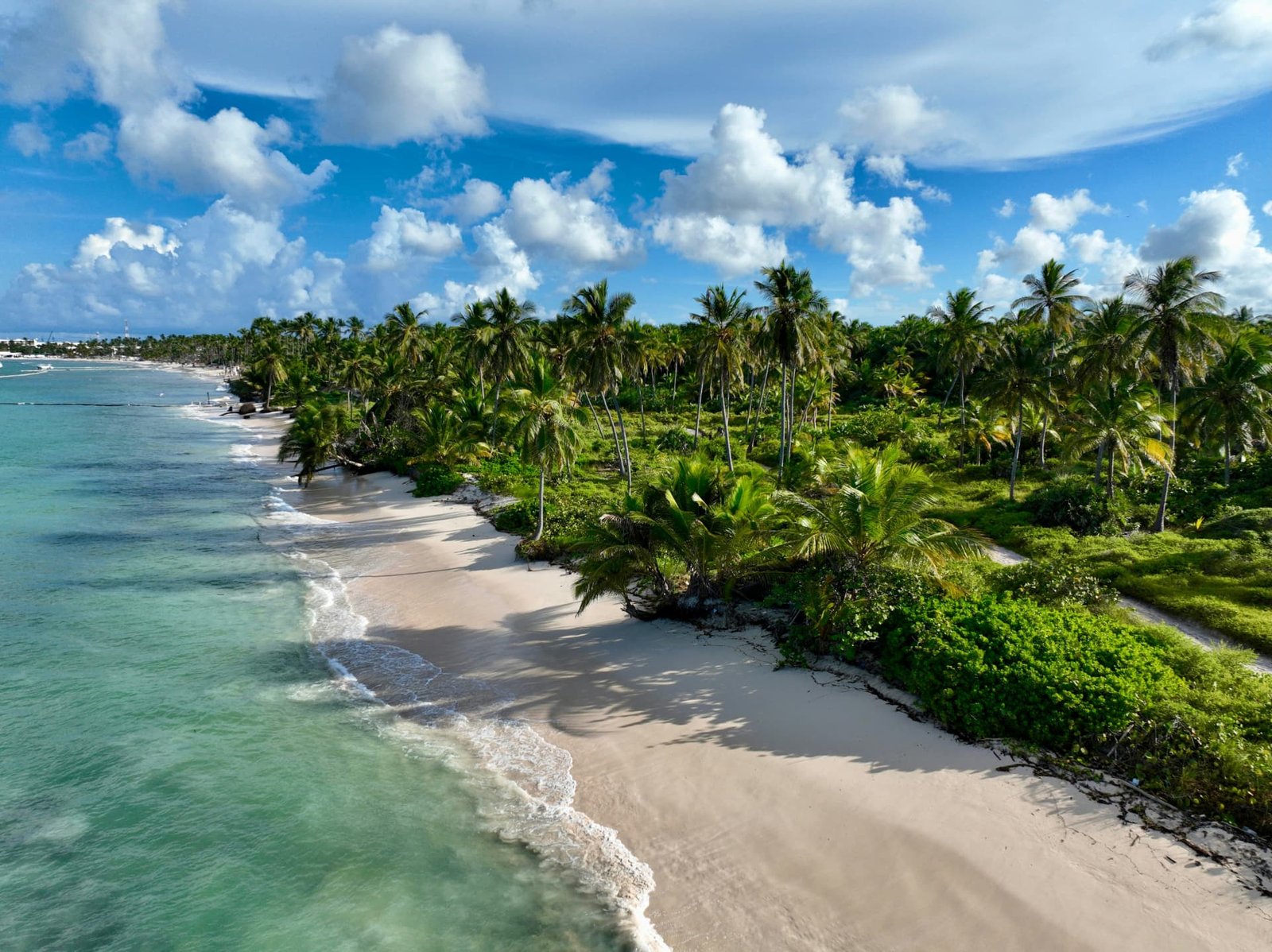
The airport is roofed in cana, the woven palm that gives the place its name, and it was built by the same company that planted a good share of the coconut palms around it. That tells you most of what you need to know: almost everything here was put there on purpose, from the road to the shade. What wasn't put there is out in front, and it holds the whole thing up — a reef a few hundred metres offshore that breaks the swell before it lands. That is why the water arrives warm and still over sand that barely slopes.

Most of the country's tourism comes through this airport, and the strip runs like a machine: wristband, buffet, transfer, excursion. What is worth your time sits at the edges of that machine. Twenty minutes from the hotel there is a public beach with real waves, a fishing settlement where they weigh the fish in front of you, a freshwater lagoon in the scrub, and a basilica the whole country walks to every 21 January.

There is no centre. No square, no seafront with any life to it, no street to walk after dinner: there is a highway with shopping centres and the hotel gates. Almost everything is priced in dollars and taxis run on fixed zone fares, so every trip out of the resort costs money again. Between May and September sargassum can shape your trip more than your hotel choice, and the colonial city is two and a half hours away by motorway, in Santo Domingo. If you want a town you can walk and a different dinner every night, Las Terrenas or the Oaxaca coast will give you that, and this is the opposite of it.

Language
Spanish. English throughout the hotel strip
Currency
Dominican pesos (DOP), though most of the tourist economy is quoted in US dollars

When to go

January to April

Dry season, and the months with least sargassum. Little rain, clear late afternoons, and from January to March the northeasterly trade wind takes the edge off the heat without lifting the sea, because the reef keeps doing its job. It is also humpback whale season in Samaná Bay, on the other side of the country, if you want to split the trip in two.

The second half of November and the first half of December: hurricane season closed, sargassum down, and Christmas pricing not yet switched on.

May to November, with hurricane season running from 1 June to 30 November. Rain here comes as afternoon downpours rather than whole grey days. The real problem in those months is different: sargassum peaks between May and September, and in October 2026 satellite reports still had Bávaro at high levels. It is not something you can plan a year ahead, so you check it the week before you travel.

Season or eventWhenWhat it changes
Christmas and New Year20 December to 5 JanuaryThe most expensive fortnight of the year, hotels full and excursions at capacity. It also happens to be the best weather, so you pay for both at once. Travelling then means booking the bed and the transfer months out.
Día de la Altagracia21 JanuaryThe country's biggest religious festival, and it happens forty minutes from here. Higüey fills with pilgrims who walk in from across the island and the basilica runs all day. It is a national holiday: expect heavy roads, and expect half your hotel's staff to wish they were there.
Carnival and 27 FebruarySundays through February, with the national parade at the end of the monthDominican carnival does not belong to Punta Cana — it belongs to La Vega, Santiago and Santo Domingo. What you feel here is the whole country on the move, and that the 27th, Independence Day, is a holiday that fills the coast with Dominican visitors.
Holy WeekMarch or April, depending on the yearThe week the country goes to the beach. Macao and the public beaches fill with Dominican families carrying coolers and speakers, which is the most enjoyable version of this coast and the least like the brochure. Everything booked out, high-season prices.

The two variables that actually change a trip here are not the month: they are sargassum and which stretch of coast you are on. The same day in August there can be a carpet of weed in Bávaro and clean water at Juanillo, because the Cap Cana reef catches part of what arrives. Before booking, check the daily sargassum map for your hotel's specific stretch, and ask the hotel whether it cleans the beach in the morning. Both take five minutes and matter more than the star rating.

Where to stay

Where to stay in Punta Cana.

See all stays
Consultando disponibilidad real en Punta Cana…

First, choose the neighborhood.

Choose the area before the hotel. In Punta Cana, it changes the trip substantially.

Los Corales and El Cortecito

The only stretch you can walk. It is the old fishing settlement absorbed by tourism: boats on the sand, fruit stalls, restaurants on the beach, and rental apartments instead of resorts.

For anyone who doesn't want a wristband. You walk out to dinner, you shop at the colmado, you eat fish without passing a reception desk.

Keep in mind: It has the most beach hawking on this coast and the persistence wears you down. And with no resort behind it, nobody is clearing the sargassum at dawn either.

Arena Gorda and Bávaro

The line of large resorts, one against the next, along the widest stretch of sand. This is Punta Cana as it appears in the photographs and where half the province's beds are.

For anyone who came not to move: clean beach, still water, everything handled inside, airport half an hour away.

Keep in mind: Behind the hotels there is nothing resembling a neighbourhood. Anything outside the grounds means a taxi, and taxis here are paid in dollars.

Cap Cana

A gated development to the south, with a checkpoint, golf, a marina and Juanillo beach, which has the clearest water on this coast because the reef filters the sargassum out.

For the quiet version, if you don't mind paying for it.

Keep in mind: You enter by showing ID at the gate, and inside there is no street life: if it isn't in your hotel or at a beach club, it isn't there. The beach clubs charge a minimum spend.

Uvero Alto

The northern end, about forty minutes from the airport. Emptier, windier, with real waves on some stretches.

For the least built-up coast without leaving the circuit.

Keep in mind: You are far from everything: every excursion adds an hour each way and dinner out stops being a realistic plan.

Punta Cana Village

The neighbourhood beside the airport that grew around the company that built it. It has a school, a supermarket, a pharmacy and neighbourhood restaurants: the closest thing to a town here.

For short stays, early flights, or anyone who wants to sleep somewhere that isn't only tourism.

Keep in mind: It is not on the beach. The sand is a short drive away, and that changes an ordinary day more than it sounds.

Where to eat

Where to eat in Punta Cana, and exactly what to order.

Reference prices per person, in Dominican pesos (DOP), though most of the tourist economy is quoted in US dollars.

Eating fish in El Cortecito

A short section, and a deliberate one. Bávaro's most visible restaurants change owner, menu and name between one review and the next, and sending you to the fashionable list guarantees this guide will be lying within six months. We would rather give you two places we understand and tell you the rest in the note below.

Capitán Cook

El Cortecito, at the end of the lane onto the beach

A fish and seafood grill on the sand, with the catch on ice at the entrance. You pick the piece, they weigh it in front of you, it goes on the coals.

What to order

The paella Doña Amalia, which is the house dish, or the whole fish of the day with tostones. Grilled lobster if you are spending.

Phone: +1 809 552 0646

The honest part: It is priced by weight, and that is where the usual misunderstanding happens: ask the price per pound before the fish goes on the scale. There is no online booking, you phone the restaurant, and going through your hotel or a middleman costs more than calling yourself. The opening hours in circulation contradict each other, so we publish none.

The dinner that isn't at the buffet

The chimi trucks on Avenida Estados Unidos

Bávaro and Verón, after dark$ · Roughly 150 to 250 pesos per chimi, depending on the stall

Grill trucks that set up at dusk along the avenue and at the entrances to Verón. This is dinner for the people who work in the hotels, once their shift ends.

What to order

A chimi: grilled pork or chicken in soft bread with cabbage, tomato and pink sauce. To drink, passion fruit juice or a very cold Presidente.

The honest part: Cash, in pesos. That range comes from the references in circulation, which hover around three dollars: treat it as an order of magnitude, not a tariff. Pick the truck with a queue of local people rather than the one closest to the hotel gate.

Most dinners here happen inside the hotel, so use them well: ask for mangú with los tres golpes at breakfast, sancocho if they have it, and la bandera dominicana at lunch, which is what the country actually eats. Outside the resort, two things are stable and don't rotate: the fish in El Cortecito and the chimi trucks. The restaurants inside Puntacana Resort, at the southern end, take outside diners by reservation, but we don't list them with a full entry because we haven't checked the menu ourselves. And the neighbourhood colmado solves more than you'd expect: water, rum, ice, fruit, and a plastic chair by the door.

What to do

6 plans, from half a day to a full day.

Playa Macao

The big public beach, about twenty minutes from Bávaro, with a low headland at one end and a bay open to the swell. There is no resort behind it, so it looks nothing like the rest: fried fish stalls, local families at the weekend, surf schools when the waves come in. People rent out chairs and umbrellas on the sand, and you agree the price before sitting down.

Check before leaving: This one does have rip currents, and it is the only beach in the municipality with lifeguards — a small team the local press has shown working with almost no equipment. Watch the flags, swim where other people are, and if you are not a strong swimmer stay at the eastern end, which is the calmest stretch.

Half a dayTransportation needed

Hoyo Azul and Scape Park

A freshwater lagoon of an almost unbelievable blue at the foot of a limestone cliff, inside the Scape Park grounds, in Cap Cana. A short trail takes you there from the entrance. The park opens daily from 9:00 to 17:00 with attractions closing at 16:30, according to its own site, which publishes no prices: the fare depends on the package and you see it when you book. Go first thing — the water under high sun is a different thing, and the groups arrive mid-morning.

Half a dayTransportation needed

Juanillo and the Cap Cana reef

The clearest water on this coast, protected by the reef that catches much of the sargassum before it lands. It is public, like every beach here, but it sits inside a gated development: you show ID at the checkpoint. The beach clubs along it charge a minimum spend for a sunbed; the sand next to them is free and identical.

Half a dayTransportation needed

Saona Island, with your eyes open

The excursion everyone sells. It is an island inside Parque Nacional del Este and the picture is real, but so is the day: boats leave from Bayahíbe, an hour and a half to two hours from Bávaro by road, so between transfers, catamaran, speedboat and the natural pool stop you are looking at eight to eleven hours depending on the operator. Before paying, get in writing what is included: the stop at Mano Juan, drinks, lunch and the protected-area fees are priced in different ways and almost never all together.

A full dayTransportation needed

The Indigenous Eyes reserve

A patch of forest with freshwater lagoons, run by the foundation of the company that developed this coast, at the southern end beside Punta Cana Village. You walk it on a trail with a guide, and it is the only place around here where you can see what was there before the hotels: native trees, iguanas, and water straight from the aquifer. It publishes neither price nor hours on its site, so ask the foundation or your reception the day before.

A morningTransportation needed

Higüey and the Basílica de la Altagracia

Forty minutes inland is the province's real city, with its market, its noise and the concrete-and-arches basilica that is the national shrine. It is not pretty in the brochure sense, and that is the point: it is where the province lives, and where the whole country arrives on foot every 21 January. Use it to eat in a comedor downtown and to see what fruit costs outside the circuit.

Half a dayTransportation needed

Getting around

From the airport to the hotel

The airport works with three authorised associations, SIUTRATURAL, BERON TAXI and ASOTATUPAL, and the fare is fixed by zone: the tables are published on its site as PDFs, worth a look before you land. The references in circulation for Bávaro sit around 30 to 45 dollars per car, and rise considerably for Uvero Alto; treat that as an order of magnitude and confirm the price before getting in. A transfer booked in advance costs about the same and saves you negotiating with luggage in hand. The local buses do not enter the airport.

Around the strip

The guagua is the local bus and costs between 50 and 100 pesos depending on the distance: you flag it on the road, you pay the conductor, it runs full. Motoconchos handle the last kilometre. The tourist taxi is a different league of price and is almost always quoted in dollars. Moving around locally, the cheapest combination is guagua plus walking; for the trip back to the airport, order the car from your hotel.

To Santo Domingo and the rest of the country

Expreso Bávaro runs Bávaro to Santo Domingo for 400 pesos one way, according to the company itself, and does not sell returns: you buy each leg separately. It leaves from the Bávaro bus station, not the airport. By car it is about two and a half hours on the motorway with tolls. If you are doing the Saona excursion or the La Romana coast, count the transfer as part of the day rather than a detail.

What most guides leave out

Your hotel's beach is not your hotel's.

All of them. Article 15 of the Dominican constitution places beaches and coastline in the public domain and declares them freely accessible, Law 305-68 sets a 60-metre strip measured from the high-tide line, and the Constitutional Court confirmed it in ruling TC/0751/23, which treats beach access as a fundamental right. In practice you will see fences, guards and stretches that look private. The sand is not: you can walk the entire coast. What belongs to the hotel is the sunbed, the towel and the bar.

The bill arrives 28% higher than the menu.

The 10% service charge is legal and mandatory when you eat in: it comes from article 228 of the Labour Code, Law 16-92. On top of that goes ITBIS, the consumption tax, at 18%. Between the two, the final bill lands about 28% above the printed prices, and it works that way everywhere — nobody is overcharging you. An extra tip is genuinely optional: leave something in cash if the service was good, and if it wasn't, you have already paid the 10%.

Sargassum decides more than your hotel does.

The peak runs May to September, with June, July and August the worst, and in October 2026 satellite reports still had the Bávaro stretch at high levels. It does not land evenly: the Cap Cana reef catches part of what arrives and Juanillo tends to hold up better, while the public beaches with no resort behind them, Macao and El Cortecito among them, have nobody clearing them at dawn. If you travel in those months, check the daily map for your specific stretch and ask whether the hotel cleans the sand first thing. Bayahíbe, to the west, is the alternative that usually stays clear.

Uber works, just not out of the airport.

Around the strip, yes, and it usually costs considerably less than a tourist taxi. At the airport it is another matter: the airport's own site still lists the Uber pickup zones as to be confirmed, and drivers avoid arrivals because of the agreement with the taxi associations. The practical move is to arrive by authorised taxi or pre-booked transfer and use the app from the hotel for everything else, including the ride back.

At Macao the sea is not the one in the photo.

It can be. Macao is open to the swell, it has rip currents and there have been drownings; it is the only beach in the municipality with lifeguards and the team is small. The still water from the brochures is the water inside the reef, in Bávaro and Cap Cana, not here. Watch the flags, don't swim alone, and stay at the eastern end if you are not a confident swimmer. If a current takes you, what the lifeguards themselves advise is not to fight it and to let it carry you until it eases.

The dollar rules, but the country runs on pesos.

Both. Hotels, excursions and tourist taxis quote in dollars and will take them, but the rate you get is poor and the change almost always comes back in pesos. The colmado, the guagua, the motoconcho and the food stalls run on pesos and on cash. Withdraw pesos from a bank ATM rather than the one in the hotel lobby, and carry small notes: breaking a thousand at a chimi truck is not always possible.

There is no town, and the one there is is called Verón.

Not the way you are picturing it. Punta Cana is the name of an area, not a city: what exists is a highway, the hotel entrances and a few shopping centres. The people who work in the resorts live in Verón and Friusa, on the other side of the road, and the province's city is Higüey, forty minutes away. If you are arriving expecting an old town, the country's old town is in Santo Domingo, two and a half hours west.

If you only have three days

The shortest itinerary that works.

1

Arrive, settle the transfer at an agreed fare, and do nothing on the first day: the water inside the reef is what you came for and it is better without a plan on top of it. As the sun drops, leave the grounds and eat outside at least once — a chimi on the avenue or fish by weight in El Cortecito, with the price per pound asked before anything goes on the scale. Withdraw pesos at a bank ATM on the way.

2

Morning at Hoyo Azul, first thing, while the water is still and the groups haven't arrived: the park opens at 9:00 and attractions close at 16:30. On the way out, drop down to Juanillo, which is next door and has the clearest water on this coast; show ID at the gate and sit on the beach rather than at the club if you don't want a minimum spend. If you'd rather have open sea than a lagoon, swap the whole day for Macao, with one eye on the flags.

3

Choose between the island and inland, because either one takes the whole day. For Saona, confirm in writing what the price covers and count the two hours of road to Bayahíbe. If you'd rather understand where you are, Higüey and the Basílica de la Altagracia in the morning, lunch in a comedor downtown, and the afternoon at the Indigenous Eyes reserve, booked the day before because it publishes no hours.